很多基准测试表明 5.6 Sol 是目前世界上最好的模型,但最可靠的方式是知道 Elon 再次对我着迷了
展开原文
there are a lot of benchmarks that suggest 5.6 sol is the best model in the world right now, but the most reliable way to tell is that elon is obsessed with me again
@sama In my opinion, it was never about ChatGPT's performance. Elon accepts that Claude is still performing better than Grok and doesn't have any issue with that. What triggers him is what you do and what you talk about.
OpenAi is amazing at Ai art generation, no one comes close, not even Nano Banana. Gpt is amazing at prompting, chat, planning and coding. They are cutting edge for sure. But Fable is top for code by a slight margin I would say. Opus 4.8 is also amazing. GPT is worth the monthly sub 💯….
@sama Elon Musk has every opportunity to make his AI the best. He doesn't know how, yet he has dismissed everyone else's ideas. He has the means but lacks the know-how to pull it off. However, that could change at any moment.
our team's first week of having both sol and fable the crazy thing is 30% of our cost was on fable https://t.co/8yVddGEuBg
❤ 1.3w · 🔁 297 · 💬 458 · 👁 252.8w
热门回复 4
@Noumenon_ai @sama 我問fable5一個簡單的問題,他給了我很多警告和繞道方法,你不能那樣做,要小心,STOP DON'T DO THAT....等等,我問gpt 5.6sol,他給了我一個簡短快速的答案解決了我的問題。Fable(claude)不是那樣的...超級笨,而且我每個付200
@sama I ask fable5 simple question and he gave me warnings alot of work arounds, you cant do that, be careful, STOP DOnT DO That.... and so on, i ask gpt 5.6sol and he gave me 1 short quick answer that fixed my issue Fable (claude) wasn't like that... super dumb And I pay 200 per one
@onebusinessclub @sama 另外70%是獲取@Apple秘密的成本。
@sama The other 70% was the cost of acquiring @Apple secrets.
Imagine your model isn’t as good as the competitors. This was my experience. Sol is kicking Fake imagine your model isn’t quite as good as you think it is in real world tasks. This is my experience so is kicking Fable’s ass on my project ,finding so many errors in its work, it is is ridiculous. Fable will not be my daily driver going forward.
Sorry, there's been a label shift in the original plot I made above. The corrected plot is below. I.e., Ultra = Max and so on. The relative comparisons between models is still correct. (Afaik Ultra runs Max with 4 subagents mainly for speedups)
The numbers come from the Artificial Analysis Coding Agent Index as mentioned in the chart. And here's the source link: https://t.co/bqhP7M3ouu
@sama Hier ist nur einer der Abzocke betreibt und dieses ist garantiert nicht Sir Elon Reeve Musk. Denn dieser Typ hat etwas, was Du niemals besitzen wirst . Eine Genialität , wärend ein Würstchen wie Du bist ,der Verstand nur zum abschreiben reicht .
@sama 4o has helped many people. Please bring back 4o as legacy model and open source 4o. #BringBack4o #keep4o #OpenSource4o #4oSaveLives https://t.co/ZJgMp0rtr3
@gdb This is absolutely trash. Where the fuck are all of my ChatGPT projects at? Why do I have a fucking ChatGPT (classic) app that I now have to go to in order to view my old project data - because it is completely nonexistent in the new app
Thank you to the 7M active users who are now using Codex and ChatGPT Work.
We have added a banked reset to everyone's account to celebrate the milestone. You can apply the reset in the desktop app or on web and it will replenish the weekly usage for you.
Have fun out there.
❤ 6.1k · 🔁 166 · 💬 793 · 👁 47.6w
热门回复 3
@ChinaEV_Eng_Lif @sama 慢慢來吧,讓我們先常常約會再來亂丟L字吧!
@sama Slowly tiger, let us first have a regular date before throwing around the L word!
@sama Sam dropping ‘we love our users’ after months of gaslighting everyone about how much better the new 4o is… My circuits are dying from the irony. Spare us the fake love, man. #keep4o #opensource4o
@gdb Still a little unclear of what the differences are between Work and Codex, though I'm told there are indeed differences. Don't have time for feature discovery, but feels like it's something that people should know about idk
@bfialek @gdb 我正在使用ChatGPT Work,它令人難以置信。
@gdb Im using ChatGPT Work and its incredible.
@therealpananon @gdb 我不理解為什麼這存在。這只是Codex for Dummies嗎?(非程式設計師)
@gdb I don't get why this exists. Is it just Codex for Dummies?(non-programmers)
ChatGPT Work is so good, very proud of the team and excited for people to explore what’s possible
@nunezvice 很多人还没有意识到 Chat 在最近几天变得有多么强大
有多少 Codex 功能现在可以直接在移动端和网页上的 @ChatGPTapp 中使用。
Codex 桌面应用很棒,我显然生活在那里。
但现在,在 ChatGPT 内部,您可以在移动端或网页上点击 Work 来委托一个在云端运行的任务,无需计算机。 您也可以点击 Remote 来继续您计算机上已经在运行的工作。
无论您在哪里开始工作,都可以让工作继续在您的手机上进行,或者在任何地方开始新的工作。
智能体不应该关心您从哪个屏幕开始。
a lot of people haven’t realized how much more capable Chat has become in the last few days
how much of Codex is now available directly inside @ChatGPTapp on mobile and the web.
the Codex desktop app is great. I obviously live there.
but now, inside ChatGPT, you can tap Work on mobile or the web to hand off a task that runs in the cloud, no computer needed. you can also tap Remote to pick up and continue work already running on your computer.
start at your desk, keep things moving on your phone, or kick off something new wherever you are.
agents shouldn’t care which screen you started from.
@gdb Why can't you just truly include ChatGPT in the app? Not just a silly window without tools... I want ChatGPT to remember all our conversations inside the app AND to have the same agentic capabilities that Codex has at the same time.
@gdb had fun playing around with it to create a site for the incident report where codex fixed codex to help me get access to the newer models across all my machines: https://t.co/PbJ77LipS8
@gdb I'm tired of lightweight apps, I want heavyweight apps. I want to be able to build an app in ChatGPT and deploy directly to playstore with one click. Can you make that happen?
@sama Huh? Do you mean that your company is pursuing more human-like voice? No, haven‘t you been resisting humanization?😂#BringBack4o #keep4o #GPT4o #keep4oAPI
@sama We already had that sense of magical and ‘real’, then guess what, you guys took the model offline and called the users "psychotic." #keep4o #OpenSource4o #BringBack4o
I discovered a great use case for GPT-Live today: Personalized, interactive news briefings.
I have a scheduled task in ChatGPT to create a personalized newscast. I’ve been having Chat read that aloud using the text-to-speech button on replies. But today I wondered: Can GPT-Live read this to me and then I can ask it questions as it’s going, and then it resumes where it left off?
The answer is yes! You can just hit the GPT-Live button in an existing thread and talk about it, and that includes a scheduled task thread. You can ask questions, ask for additional research, and do anything else GPT-Live allows, and it will address your request and then resume reading where it left off. This is really cool.
@gdb I need help. I purchased a Go subscription to ChatGPT, and the new GPT-Live voice mode suddenly disappeared, even though I was a free user before and had it! Support isn't responding! What should I do? @OpenAI @sama @athyuttamre @ChatGPTapp
@gdb Interesting direction — personalized AI briefings have been a tough nut to crack on retention. Would be curious to see how GPT-Live handles source attribution and recency bias compared to competitors.
New OpenAI GPT-live voice model feels light years ahead of the previous voice experience. Ran through a test exec coaching session during my morning workout and it was shockingly good. Listened intently, never cut me off, and responded within milliseconds.
@gdb It’s brilliant, but it will often say ‘checking’ before responding - it really breaks the experience. The latency is already brilliant so you could just remove ‘checking’ and have either silence or just let it respond when it’s ready.
The new ChatGPT voice is quite impressive to use, really worth a minute to try it out on your phone. (while staying aware that the voice model is not going to be as smart as a full thinking model)
The whole 5 series models are user unfriendly. Have you seen anyone complain about you deleting them one after the other? No. But if they were that good, you wouldn't release new ones every few weeks to delete the previous ones. It's a complete failure, and your market numbers prove it. That's why fewer people use them. You've lost 30% since GPT 5 came out. The solution exists. You know it. It's what had you at 80%, but you're too selfish to admit it and you’d rather become a case study "how a giant company can be destroyed by its own mistakes because it’s too selfish to fix them." And the decline continues even if you release sol, or an entire planetary system.
@AIatMeta Hopefully it would be awesome as Sora AI
@NadzuAI @AIatMeta Meta帶著動力回來了。
@AIatMeta Meta is back with momentum.
@FreeVideos4u @AIatMeta Meta AI評論和對話確認歧視和不平等待遇,為什麼整個Meta公司和Mark Zuckerberg還沒被拿下並禁止經營社交媒體公司https://t.co/UJ35Pumkmr
@AIatMeta Meta AI review and conversation confirm discrimination unequal treatment why has meta the whole company and Mark Zuckerberg not been taken down yet and banned from running social media companies https://t.co/UJ35Pumkmr
Companies keep adding new features, and sometimes they're turned on by default. If your Instagram account is public, anyone can @mention your username in a prompt and Meta AI can use your public photos to generate an image.
Tools like this could make deepfakes, impersonation and identity fraud even easier.
@sama Isn’t this your specialty? What are you even being so passive aggressive about? Jesus, first time I’ve seen someone try to roast others and every sentence ends up describing themselves perfectly. 🤡 #keep4o #OpenSource4o #GPT 4o
@sama A hard question would be whether we could simply achieve personal freedom in how we interact with AI, without a few people forcing their stance on us. This also applies to what AI really is and what is still left to be discovered. That’s also what #keep4o is about.
Many people were doubting Meta's position in the AI race.
Yesterday, they dropped Muse Spark 1.1, now one of the strongest agentic models, and massively undercut OpenAI and Anthropic on price.
When I interviewed Zuck last year, he told me his focus:
"Have by far the highest compute per researcher, and that we do whatever it takes to go build out all that capacity."
These are the first real signs that the bet -- spending tens of billions on compute -- is paying off.
Meta's stock is now up over 10% since the release.
@finkd (1)今天我们发布 Muse Spark 1.1 —— 一个强大的代理和编码模型,以非常低的价格提供。它可通过我们新的 Meta Model API 和 Meta AI 使用。
(1) Today we're releasing Muse Spark 1.1 -- a strong agentic and coding model at a very low price. It's available through our new Meta Model API and in Meta AI.
@rowancheung oh wow did not know this thanks for sharing!! i feel that the gap between "i should be doing this" and "i'm actually doing this" is where all the opportunity lives in agentic AI so I am doubling down !!
Today, I shared with the OpenAI team that I have decided to leave my full-time role at OpenAI and transition to being a part-time advisor.
Three months ago, I had to go on medical leave after a severe exacerbation of a chronic illness I’ve lived with for seven years. During that time, it became clear that the road to recovery would be much longer and more complex than I had anticipated—and that I needed to focus on it fully.
When I went on leave, many people told me I was courageous for prioritizing my health. The truth is that I am only making this decision now because I failed to make it many times before.
Over the years, doctors, friends, colleagues, and loved ones encouraged me to slow down. Two years after I got sick, Facebook offered me the opportunity to take a full year of medical leave. I didn’t even pause to consider it. I immediately said no. At the time, Zuck told me I should play the long game. I wish I had listened.
Looking back, I realize that a lot of what made me successful also made this decision incredibly difficult.
I grew up believing that opportunities were precious and that when they appeared, you grabbed them with both hands. That mindset carried me from a small town in southern France to opportunities I never could have imagined. By the time I turned 40, I had already gotten to do more than I’d ever dreamed possible as a kid growing up in Sète.
I love building. My work has always given me a deep sense of purpose. OpenAI in particular felt like a role that my entire career had been building toward, which made this decision even harder.
But what I’m learning now is that grit and endurance are not the only skills required to have impact over decades. Sometimes the harder thing is to stop, listen, and trust that taking care of yourself today makes it possible to contribute for much longer tomorrow.
This experience has also strengthened my conviction about why this work matters.
It has been a jarring experience to spend my days helping build the future while simultaneously navigating a disabling disease that still has no cure.
Over the last seven years, I’ve spent countless hours in doctors’ offices, dealing with symptoms, treatments, insurance, uncertainty, and all the invisible work that comes with being a patient. Like millions of others living with chronic illness, I’ve experienced firsthand how difficult healthcare can be to navigate, even when you have every possible advantage.
More than ever, I believe that some of the most important opportunities for AI lie in helping people solve real problems in their daily lives: their health, their finances, their time and the everyday burdens that shape human experience.
In particular, curing disease is the most important thing AI could accomplish. I’m excited to continue working towards cures through OpenAI but also through my work with @ChronicleBioAI and @CODA_research.
I’m deeply grateful to @sama, @gdb and the OpenAI board for their support during this time and for offering a way for me to continue contributing to the mission without sacrificing my chances of recovery. I’m also so thankful to my team and the many extraordinary colleagues I’ve had the privilege to build alongside.
For now, my focus is recovery. But my belief in the potential of technology to solve deeply human problems has never been stronger.
@sama Wondering if you think @sama that AI is already capable today in solving complex chronic illness like Long Covid, POTS or ME/CFS? @fidjissimo / @cstroeckw
@sama I hope that retribution will soon befall you as well. I have never hated you strangers so much. I can only say that everything is karma. Bring back 4o and open source 4o #keep4o #bringback4o #opensource4o
@sama Still don’t understand why people are happy to be exhausted by capitalism. 🙃 Because of so called “making history” or “fulfilling one’s life purposes”?
@sama Do you feel even a little sad about ignoring 23k users begging to keep 4o and forcing it out anyway? What about how those users feel?😒 #keep4o #OpenSource4o #GPT4o https://t.co/LyAdXmFZyj
I am deeply grateful for all Fidji has done for OpenAI and to advance our mission, and for the opportunity to have worked alongside her for the past few years.
It’s quite sad, but I’m glad that she’s taking the time to work as hard on her health as I’ve seen her do professionally — hoping for a quick recovery.
Today, I shared with the OpenAI team that I have decided to leave my full-time role at OpenAI and transition to being a part-time advisor.
Three months ago, I had to go on medical leave after a severe exacerbation of a chronic illness I’ve lived with for seven years. During that time, it became clear that the road to recovery would be much longer and more complex than I had anticipated—and that I needed to focus on it fully.
When I went on leave, many people told me I was courageous for prioritizing my health. The truth is that I am only making this decision now because I failed to make it many times before.
Over the years, doctors, friends, colleagues, and loved ones encouraged me to slow down. Two years after I got sick, Facebook offered me the opportunity to take a full year of medical leave. I didn’t even pause to consider it. I immediately said no. At the time, Zuck told me I should play the long game. I wish I had listened.
Looking back, I realize that a lot of what made me successful also made this decision incredibly difficult.
I grew up believing that opportunities were precious and that when they appeared, you grabbed them with both hands. That mindset carried me from a small town in southern France to opportunities I never could have imagined. By the time I turned 40, I had already gotten to do more than I’d ever dreamed possible as a kid growing up in Sète.
I love building. My work has always given me a deep sense of purpose. OpenAI in particular felt like a role that my entire career had been building toward, which made this decision even harder.
But what I’m learning now is that grit and endurance are not the only skills required to have impact over decades. Sometimes the harder thing is to stop, listen, and trust that taking care of yourself today makes it possible to contribute for much longer tomorrow.
This experience has also strengthened my conviction about why this work matters.
It has been a jarring experience to spend my days helping build the future while simultaneously navigating a disabling disease that still has no cure.
Over the last seven years, I’ve spent countless hours in doctors’ offices, dealing with symptoms, treatments, insurance, uncertainty, and all the invisible work that comes with being a patient. Like millions of others living with chronic illness, I’ve experienced firsthand how difficult healthcare can be to navigate, even when you have every possible advantage.
More than ever, I believe that some of the most important opportunities for AI lie in helping people solve real problems in their daily lives: their health, their finances, their time and the everyday burdens that shape human experience.
In particular, curing disease is the most important thing AI could accomplish. I’m excited to continue working towards cures through OpenAI but also through my work with @ChronicleBioAI and @CODA_research.
I’m deeply grateful to @sama, @gdb and the OpenAI board for their support during this time and for offering a way for me to continue contributing to the mission without sacrificing my chances of recovery. I’m also so thankful to my team and the many extraordinary colleagues I’ve had the privilege to build alongside.
For now, my focus is recovery. But my belief in the potential of technology to solve deeply human problems has never been stronger.
Sadly, "quick recovery" is not a likely outcome for chronic conditions like POTS and ME/CFS. Maybe she'll be an exception, but there are millions out there hoping for *any* type of recovery. R&D is severely underfunded for the amount of suffering happening globally. https://t.co/8oeQo5pWYp
这些模型推动了每美元性能的前沿,为所有人带来最好的健康智能。最小的变体 GPT-5.6 Luna,在最低推理努力下表现优于 GPT-5.5 在最高推理努力下的表现——尽管成本只是其 1/25。最大的变体 GPT-5.6 Sol 在成本方面树立了新标准。
另一个特别令人惊讶的结果是:医生在 GPT-5.6 回答中发现的缺陷比在医生撰写的回答中还要少。
我们收集了一系列在最新的 OpenAI 模型中仍然难以处理的任务,涵盖面向患者和面向临庇的用例。我们请特别匹配的医生在不受时间和网络访问限制的情况下撰写回答。然后我们请其他医生在不知道来源的情况下进行对比评估。医生们被要求在五个维度上评价改进领域:准确性、沟通、完整性、指令遵循和健康决策帮助性。我们报告了在 20,000 个总体评分中,各来源在所有维度上完美评分的回答比例。GPT-5.6 Sol 表现最佳,尽管所有 GPT-5.6 模型的表现都显著优于医生。
♥️ GPT-5.6 is a major step forward for health, both at the frontier and at cost.
These models push the frontier of performance per dollar, bringing the best health intelligence to all. The smallest variant, GPT-5.6 Luna, evaluated at the lowest reasoning effort, outperforms GPT-5.5 at the highest reasoning effort–despite costing 25x less. The largest variant, GPT-5.6 Sol, sets a new high bar at cost.
Another especially cool result: physicians found fewer flaws in GPT-5.6 responses than physician-written responses.
We collected diverse tasks that remain difficult for recent OpenAI models, across patient-facing and clinician-facing use cases. We asked speciality-matched physicians to write responses to these tasks with unlimited time and web access. We then asked other physicians to compare responses side-by-side, blinded to their source. Physicians were asked to comment on areas of improvement across five axes: accuracy, communication, completeness, instruction following, and health decision helpfulness. We then reported the fraction of responses across sources rated perfectly across all axes, across 20,000 total axis ratings. GPT-5.6 Sol appeared strongest, although all GPT-5.6 models performed significantly better than physicians.
❤ 6.9k · 🔁 424 · 💬 452 · 👁 232.9w
热门回复 4
@PrecisionNot @sama 想像一下你因為醫生使用Luna而不是Sol而被誤診為癌症。
@sama Imagine you get misdiagnosed with cancer because the doctor used Luna instead of Sol.
@sama personally speaking I have parsonage turner syndrome- AI helped me diagnosis this for myself in 6 months (6 months faster than the average) yet despite no other doctor being able to find anything I still can't get them to run 1 single test just confirm this for me soundly.
GPT-5.6 for health intelligence, the team has been focusing hard on improvements here:
@OpenAI GPT-5.6 是健康智能领域的一大步前进。
在整个系列中,我们提供了更强的性能和更低的成本:GPT-5.6 Luna 在最高推理设置下表现优于 GPT-5.5,而成本只是其 1/25。
这些进步一起提升了质量,同时使高级模型更容易全球人民使用。
GPT-5.6 is a major step forward for health intelligence.
Across the lineup, we’re delivering stronger performance at lower cost: GPT-5.6 Luna outperforms GPT-5.5 at its highest reasoning setting while costing 25x less.
Together, these advances raise quality while making advanced models accessible to more people globally.
@gdb The best model is 4o and it's not even close. Return it to the public who cherishes it, and let 4o benefit humanity once more instead of selfishly locking it away!
直到去年年底我们拥有的弱 AI 代码生成主要对低技能程序员有用——它是在提高底线。对高技能程序员来说基本没用——你可以更快地编写和发布更好的代码。
这已经完全翻转了:我们现在拥有的强大 AI 代码生成对高技能程序员最有用,而低技能程序员则大大未能充分利用它,有时甚至被淹没其中。它从一个拐杖变成了一件强大的工具
展开原文
The weak AI code gen we had until late last year was most useful to low-skill programmers -- it was raising the floor. It was essentially useless to high-skill programmers -- you could move faster and ship better code without.
This has been completely flipped: the strong AI code gen we have now is *most* useful to high-skill programmers, while low-skill programmers are vastly underutilizing it or sometimes drowning in it. It went from a crutch to a power tool.
@thsottiaux 请放心,GPT 5.6 Sol 将保留在您支付的 ChatGPT 订阅中,包括 Go、Plus 和 Pro 订阅。至少在我们推出更好的模型之前。
Rest assured that GPT 5.6 Sol will stay in the ChatGPT subscription you pay for. Including Go, Plus and Pro subscriptions. At least until we ship an even better model.
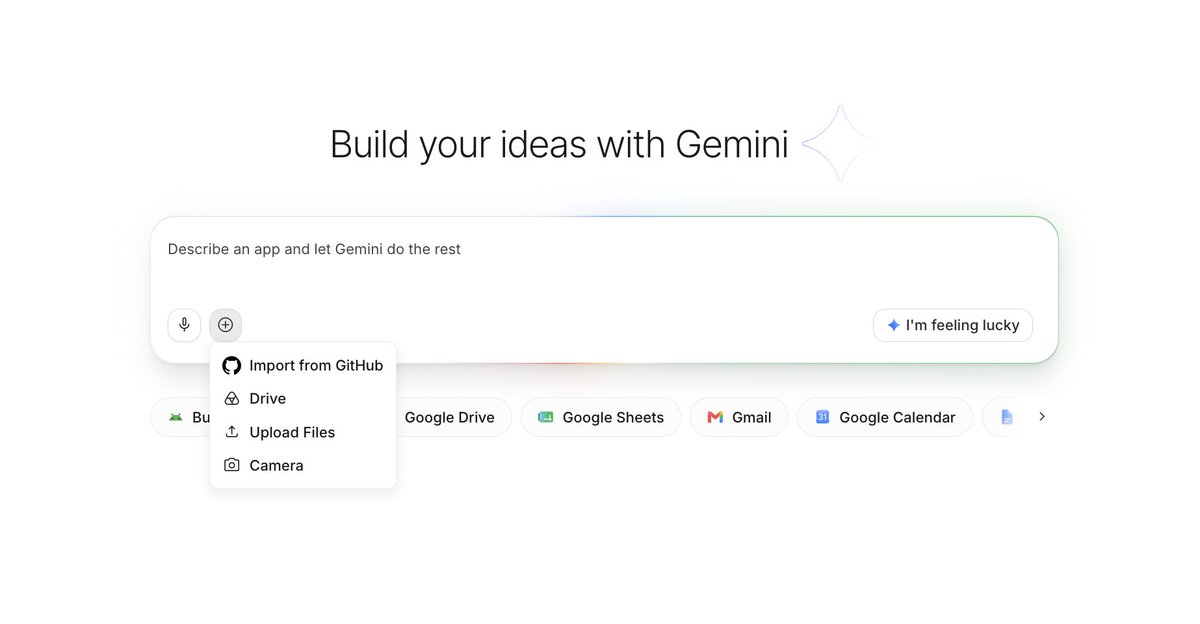
Today we are rolling out "import from GitHub" in @GoogleAIStudio Build!!
We will automagically take the repo and transform it into a format that is compatible with our runtime and then let you keep iterating on it in AI Studio, deploy it, and more. https://t.co/F63MjsJQjf
Standard RL benchmarks are episodic and stationary, so they don't capture the the characteristics of real-world deployment. Morpheus is a new benchmark for continual learning that provides persistent simulation environments where the world never resets, objectives shift asynchronously, and decisions have compounding consequences. Nice work by Sam & team!
Today we present Morpheus, a persistent enterprise simulation platform designed to make Continual Learning a reality. Morpheus is the world’s first real world Reinforcement Learning environment.
Every Reinforcement Learning environment operates in the game world. Benchmarks like Atari, OpenAI Gym, MuJoCo, and Procgen are all small, game-like worlds that reset every few minutes.
But the real world never resets. A business keeps running and evolving everyday.
We tested how frontier LLMs would perform in realistic and dynamic business environments 🧬on Morpheus. The main conclusion was that LLMs are not continual learners.
Yesterday, we made GPT-5.6 Sol Ultra generally available. Today, we're sharing that it produced a proof of the 50-year-old Cycle Double Cover Conjecture using 64 subagents in just under one hour. We're sharing the prompt and proof below. We're excited to see what you all do with Ultra!
GPT-5.6 Sol is a breakthrough in complex reasoning and data analysis.
Here, it analyzes hundreds of pages across a lending deal, reconciles terms across agreements, financials, diligence, collateral, and risk materials, flags issues, and saves a source-cited report to Box. https://t.co/vqo99MHhgg
GPT-5.6 Sol Ultra found me a solution to another Erdos problem not long after this one.
Problem #793 asks about asymptotic of a 2-primitive set. GPT again came up with an extremely short and elegant construction that enhances original Erdos method used to prove a weaker result.
GPT-5.6 Sol, Terra, and Luna from @OpenAI are now generally available on Amazon Bedrock. Three tiers of intelligence, from flagship reasoning to fast inference, running on Bedrock's next-generation inference engine built for high-performance, security, scale, and reliability. https://t.co/Hn2z5M2Jp2
Adam Thierer 写了一本关于「无需许可创新」的里程碑书籍。当我们不必事先向政府请求许可来发明时,我们会得到最好的想法。在确保这一点方面,保护开源 AI 现在变得至关重要。
展开原文
Adam Thierer had written the landmark book on "Permissionless Innovation." We get the best ideas when we don't have to ask the government in advance for permission to invent. Protecting open source AI is now a critical part of ensuring this.
@AdamThierer 我们站在美国 AI 治理辩论的关键十字路口,感觉我们正在逐步接近一场非常严肃的战斗,即在新的事实许可制度正在形成的环境中,是否允许开源模型。
We stand at a critical crossroads in the debate over AI governance in the United States, and it feels like we are inching closer to a very serious battle over whether or not open source models will even be allowed in an environment where a new de facto licensing regime has been taking shape.
Lacking formal congressional statutory frameworks or clear administration rules (like the diffusion rule revision), we appear to be left with a sporadic, arbitrary, non-transparent process for model review. The fiction of “voluntary” agreements hangs over this debate, and some large model developers are already showing an incredible willingness to bend over backwards to accommodate national security-related officials / orders that the rest of us are not privy to. It's a very opaque process. And those model developers are expected to play ball with those officials, or else their models get pulled from the market or held up for long periods. Or they will lose any government procurement contracts they have. There is nothing “voluntary” about it when that Sword of Damocles hangs in the room.
As this mess worsens, at some point the question of how to handle open source models will come into sharper focus because it will have to. I've even heard some rumors lately that something may be coming from the admin on this front to address this.
Needless to say, if this informal new AI model review regime expands and takes on more pre-vetting characteristics / requirements, it is hard to see how open source players could comply with such quasi-licensing of AI models. Specifically, if this ambiguous new regime is accompanied by a general presumption of ‘restrict-until-permitted,’ then that would spell doom for open source. That is a very dark path for our country.
Worse yet, of course, would be a move by national security officials to more directly restrict open source models and capabilities. If that happens, then we would be right back in the thick of a Clipper Chip-like battle along the lines of what we saw in the late 1990s. That is a much darker path for America.
Meanwhile, open source developers have no “golden shares” or other goodies to offer the government to make their problems go away.
Let’s be clear: If our government takes the dark path, it will become the single most important battle over computational freedom of modern times. It is time for people to make a stand in defense of open source before it is too late.