Trump: "We need $2 billion daily to reopen the Strait of Hormuz."
Chinese FM: "The Strait was open before the war. The root cause is your illegal operations against Iran; you created a global crisis from nothing." https://t.co/OmFMkVpfUk
@OpsHQs For once (and this is rare), I agree with China! Especially after Trump claimed that Iran's strike ability was fucked. Looks like it was no where near fucked.
@OpsHQs @LeaBlackMiami Trump keeps lying hoping ev1 will 4get the Strait was freely open b4 he started a needless illegal war that has killed 14 American soldiers 170+ girls in a Iranian school, Guessing the POS hopes his underwear uneducated #MAGACultMorons believe https://t.co/k3TYcfdv1n
One of the largest public crypto companies in the world just DUMPED OpenAI and Anthropic.
Coinbase switched to open-weight Chinese models from Zhipu and DeepSeek, and shaved nearly 50% off the company's internal AI spending.
The numbers are absolutely ridiculous:
Running the same enterprise workload through Anthropic's Claude costs $4,811. Running it through Zhipu's GLM 5.2 costs $544. That's a 9x price difference for equivalent output.
OpenAI's GPT-5.5 sits in the middle at $3,357. DeepSeek's V4 lands at $1,071. Moonshot's Kimi at $948.
On the actual benchmarks: Zhipu's GLM 5.2 scored 62.1 on SWE-bench Pro, the gold standard for coding. OpenAI's GPT-5.5 scored 58.6.
One AI researcher called GLM 5.2 "at least as good as Opus 4.8 and GPT 5.5." Another called it "the first open model that can really compete with closed-source systems."
The Chinese models are not just cheaper but they are now also beating American models on the benchmarks American companies pay $4,811 per workload for.
Coinbase did the math first and reacted - more companies will certainly follow.
Now watch what happens to the IPO timeline:
Anthropic confidentially filed for an IPO targeting October at a $965 billion valuation. OpenAI followed days later with its own confidential filing.
Both companies built their financial models on the assumption that they could keep charging enterprise prices that are 9 to 33x what Chinese competitors charge for the same task.
Brian Armstrong publicly proved customers WILL leave.
45% of companies are now spending over $100,000 per month on AI, up from 20% last year. Every one of those customers is one quarterly budget review away from dumping American AI.
OpenAI has reportedly already started preparing major token price cuts.
Anthropic is expected to follow.
And here's the thing...
The export controls were supposed to CRUSH Chinese AI.
The US government banned American AI chips, restricted model weights, blacklisted Alibaba and Baidu as Chinese military companies, and just banned Anthropic's flagship model from every foreign national on the planet. The entire premise of the American AI valuation bubble is that Washington can keep China two generations behind.
But Chinese labs responded by building cheaper, more efficient models on inferior hardware and pricing them at one ninth the cost of the American alternative.
And now American companies are voting with their checkbooks.
The dominant American labs are valued at nearly $2 trillion combined on the assumption that their pricing power is durable. Coinbase proved it is not, and every customer doing a year-end budget review will be looking at the same math.
For investors, the question here is what happens to the Anthropic IPO at $965 billion when the company is being forced to cut prices to defend share against open-weight Chinese models that score higher on the benchmarks.
For everyone else, the bigger question is what happens when Washington spent four years and billions of dollars trying to contain Chinese AI, and the only thing that actually shifted in the end was American customers.
Have you tried GLM 5.2 before? I am from China and interestingly enough I never used or rarely used those LLMs from my own country for serious work, I use American ones all the time, i have tried some small sizes LLMs locally in my desktop but they really look like toys for me i would say
JUST IN: 🇨🇳 Ex Meta PM and AI founder Xiaoyin Qu says “American and European enterprises will ditch OpenAI and anthropic and adopt Chinese models.” https://t.co/yiIriM84ed
@WhaleInsider longcat llm from a food delivery app is already free on openrouter and opens top 4 of token usage. think about it guys https://t.co/ZQXBd8zdJb
The worst-case scenario for the United States is becoming increasingly realistic, and I will briefly explain why.
@quxiaoyin raised many valid points, and I agree with her. First of all:
-China certainly does not place such strong emphasis on open source because it cares so deeply about humanism, but because it is a strategy to attract many users, gain market share, put pressure on US models, and also because the models are increasingly being trained on Huawei hardware (think of DeepSeek 4), allowing China to host the entire stack domestically.
-But the underlying logic is far more important: The United States is still building too few data centers to meet future demand. @ChrisGillett wrote an outstanding analysis on this, which I shared a week ago. In short, based on SemiAnalysis data, demand is greater than what is currently being built in terms of data centers.
-Even more importantly, however, the United States lacks sufficient energy and grid capacity. This is a problem that will become much more severe in the near future. China, by contrast, is addressing the issue through a massive expansion of its energy supply. Solar capacity: in 2025 alone, China installed as much solar capacity as the United States did in 10 to 15 years. China is also building 36 nuclear power plants, significantly more than the United States, and is installing them faster.
-In addition, China is managing to become more independent through Huawei chips, even though the country still lags far behind NVIDIA. But here, China is betting on quantity rather than quality.
In short: China is a real threat in the AI race, and the situation for the United States is becoming increasingly precarious. This is also the main reason why China is to be kept away from SOTA LLMs at all costs, so as not to jeopardize the lead under any circumstances.
The worst case scenario for USA AI: 1. Chinese open sources keep gaining market share. China owns the model layer. 2. Those models were trained and inference-optimized on Huawei chips instead of NVIDIA. China also owns the chip layer. 3. US doesn't build data centers fast enough to keep up with the demand of compute, storage and energy. China meanwhile exports the inference and training layer(for continual training it will happen along with inference) Export control is not the right strategy here. Simply banning "open source from China" doesn't solve the issue here. USA must invest in open source models, hopefully get Chinese models to use NVIDIA, and invest in nuclear asap.
Hey Peter, good question. Of course, I can only speculate, but based on how things are currently playing out, my guess would be this:
Future releases of absolute frontier models will no longer look the way they have so far. Models on the level of Mythos, which was apparently only rolled out in a tightly controlled setting like Project Glasswing, are likely to either come with massive guardrails ("Fable 5") or be made accessible only to selected trusted partners.
I increasingly believe that public access to the strongest frontier models at any given time is over.
The best models will probably no longer simply be available through public access, but will instead be provided to selected partners through Glasswing-like programs: research institutions, government agencies, certain companies, in other words, actors for whom there is at least a very high probability that no leak to China or other unauthorized actors will occur.
Whether this can really be guaranteed 100 percent, I do not know. Probably not. AI 2027 has played out exactly this risk as a scenario. But politically, the direction seems clear.
At its core, this was also precisely what the US government demanded of Anthropic: no foreign companies, no foreign employees, maximum control over access and deployment. And I think this expectation will in the future be directed not only at Anthropic, but at all frontier labs.
You can already see this with OpenAI. Sam Altman was asked a few days ago whether GPT-5.6 would also be available outside the United States. His answer, in essence, was that they were working hard on it. To me, that very clearly suggests that there is currently no clear green light from the US government.
In short: Whether this will work in practice remains open. Probably never completely. But I believe the US government will in future require all SOTA models to be released to trusted partners only under maximally controlled conditions.
So my thesis would be: We are currently witnessing the end of public access to the best frontier models available at any given time.
And one final point: by "at all cost," I mean that the US government is well aware that even the current embargoes affecting Anthropic are creating market uncertainty. However, compared to national security and future dominance, this is prioritized over the valuation of private companies or future data center capex.
@kimmonismus @quxiaoyin The US grid crunch won’t be solved by building data centers faster alone.
Storage networks can park capacity near power that already exists and dodge the interconnection queue instead of trying to get through a grid buildout.
@kimmonismus @quxiaoyin Your summary of Xiaoyin's points are good but your conclusion - "This is also the main reason why China is to be kept away from SOTA LLMs at all costs" - how do you expect to do this? The current approach to delay access?
@kimmonismus @quxiaoyin Never forget. You are in the middle of a war. It is on all fronts. Technological, geopolitical, and most importantly psychological. You lose 100% of the wars you don't know you're in. Wake up. We can't falter now. Do not take the rat poison. Fear is for losers. AGI or bust. https://t.co/2QumpYhuO6
Remember the Jensen interview with Dwarkesh? Banning NVIDIA chips was a huge mistake. Deepseek was trained optimizing Huawei chips already and more Chinese labs will adopt the same. Cutting ties with China hoping that would kill their AI progress was a policy mistake. Export control on Fable was a mistake. Banning NVIDIA was a mistake. AI is a paradigm shift, and to win you must play the long game and make sure everyone adopts you first. US starts the AI revolution but being closed is NOT the right strategy. It's short-sighted, and lacks strategic vision.
First they blocked ASML's machines, then Nvidia, now fable. This is nothing but forcing China and other Asian countries to give birth to these core tech that they wouldn't otherwise think of having to except for AI. It was a win-win situation if Chinese models were trained and using inference on Nvidia chips, which they would have had difficulty leaving for another chip manufacturer. ASML's EUV lithography is still hard to crack, even Japanese giants like Nikon and Canon have given up on it kver a decade ago
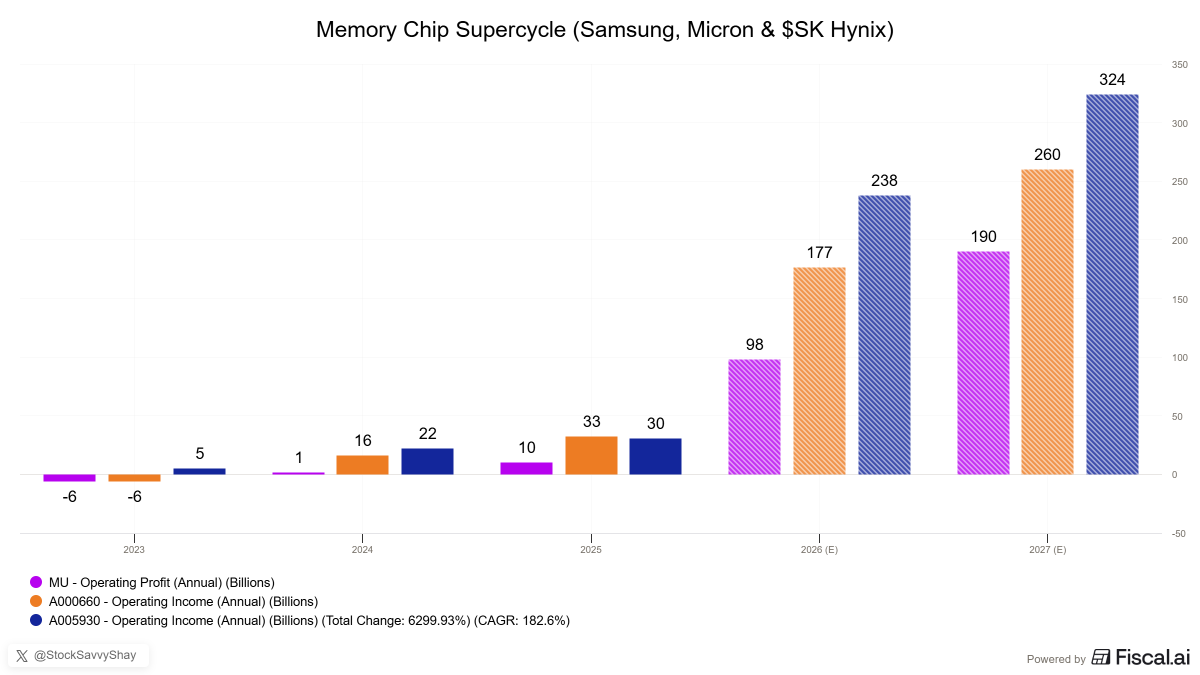
Absolutely wild that $MU, Samsung and SK Hynix went from losing money to generating a combined ~$775B in annual profit within five years.
AI has turned memory into the bottleneck of bottlenecks with data center demand bidding up HBM, tightening DRAM supply and making memory the tax every AI workload has to pay.
That slope is indeed exaggerated. If AI capital expenditure continues to remain high, the "tax" on memory usage will likely continue to be collected.
Currently, SK Hynix is the most favored, followed by MU (HBM has the most aggressive capacity expansion). Despite its large size, Samsung is lagging behind in HBM development.
@StockSavvyShay @fiscal_ai Never know if there is that silent pact. They haven’t produced any additional inventory. They just raised prices. They were never a big margin business. Did we forget companies like Intel where it was 1 year ago?
@StockSavvyShay @fiscal_ai memory was the one commodity nobody wanted to own and now it's the tax every ai workload has to pay. micron printing more than meta this year is the whole regime change in one ticker
The memory supply-demand gap will keep widening through 2027. That is the real reason Apple is lobbying the White House to keep CXMT off the Entity List.
▌Start with my latest industry checks: The pressure on Apple has shifted from soaring memory costs to a widening supply gap.
1. Of the memory capacity allocated to consumer electronics in 2026, an estimated 15–20% is expected to shift to data centers in 2027, and that share could grow.
2. Due to tight memory (LPDDR) supply, Apple's actual pull-in volume of A20 chips in 2H26–1Q27 could be 10–20% below its original target (though part of that may reflect Apple’s own overbooking).
▌CXMT states in its IPO prospectus that its capacity is far below domestic demand. Given the persistent global memory imbalance, even if Apple’s lobbying succeeds and it buys DRAM from CXMT, that would not materially lower costs or fill the supply gap. Still, with the imbalance widening, Apple has every reason to secure an additional source.
▌This also explains why Apple is being more proactive this time than it was when it evaluated YMTC in 2022. YMTC was mainly about lowering NAND costs; CXMT is about managing DRAM supply risk.
▌Tim Cook is one of the few tech leaders who can still navigate both Washington and Beijing, so this is better handled before he steps down as CEO. Even if the effort goes nowhere, the media coverage can still leave the market with the impression that Apple tried but was constrained by U.S. policy. That may help ease frustration over price hikes and longer delivery times.
CXMT has stated in its prospectus that its capacity is far below China's domestic needs. Even if Apple succeeds in buying from it, the volumes would not meaningfully close the overall gap or deliver big cost savings. Still, Apple sees value in securing an additional source as imbalances persist.
@mingchikuo @apple has been robbing the consumer blind on massive memory price markups with no incremental @Apple value add for years.....now someone does it to them and they cry like little school girls 😭😭 🙄 https://t.co/RVFxacIOQm
They're lobbying because supply is becoming the bottleneck.
As AI data centers absorb more LPDDR capacity, consumer devices compete for the same memory. In the end, whoever controls memory supply controls the AI hardware race. Follow the bottlenecks, not the headlines.
>>TSMC Teams Up with Winbond to Build a Homegrown DRAM Supply Chain for AI
• Amid deepening global memory shortages, TSMC has brought Winbond into its AI chip supply chain. The two companies will collaborate on next generation WoW (Wafer on Wafer) 3D stacking technology, with Winbond supplying DRAM wafers and TSMC stacking them with logic wafers for use in AI chips.
• TSMC has historically relied on Samsung Electronics, SK Hynix, and Micron, but as the supply shortage has intensified, it is seen as moving to diversify its sourcing. The industry views this partnership not as a simple supply agreement but as part of a TSMC strategy to cultivate a memory supply chain within Taiwan and strengthen the supply stability of its AI chips. Winbond, for its part, is expected to use this as a springboard to enter the AI server and high performance computing supply chains in earnest.
2、连接性:AI 基础设施的真正瓶颈 Murphy 在演讲中抛出了一个核心问题:什么定义了 AI 基础设施的性能?大多数人会想到处理器、GPU、制程节点(3nm、2nm 甚至未来的1.4nm、1.6nm),或者高带宽内存。这些当然重要,但 Murphy 指出,这些都不是系统的决定性特征。
“因为一个处理器,无论它有多快、连接了多少内存,对于今天的 AI 工作负载来说根本不够。你需要数万个、最终是数百万个处理器作为一个单一的大规模计算引擎协同工作。这就是为什么这种规模的计算从根本上是一个连接性挑战。”Murphy 说道,“而且越来越多地,正是连接性的架构和特性定义了系统的性能。”
这个判断得到了英伟达 CEO 黄仁勋的呼应。在 Murphy 邀请下登台的黄仁勋强调,AI Agent 的计算模式是“分解和分布式的”(disaggregated and distributed)——当你把一个计算问题分解成许多部分,并分布到整个数据中心时,连接性就成为必需品。“我们分解和分布式计算,使其运行在这些巨大的集群上,这样我们就能聚合总计算量、总内存和总带宽。而使这一切成为可能的,就是连接性。”黄仁勋说,“这就是为什么 Matt 做得这么好,为什么 Marvell 如此关键。”
Murphy 进一步解释了连接性瓶颈的演变逻辑:过去几年,AI 基础设施先后解决了计算瓶颈(英伟达引领的 GPU 革命)和内存瓶颈(HBM 高带宽内存的规模化),现在瓶颈正在再次转移。“现在是连接性将定义基础设施的极限,就像计算和内存一样。”他引用了与最大客户的对话:“世界上最大的超大规模云服务商现在正在重新构想他们的整个网络架构。他们认识到,扩展 AI 基础设施现在首先是一个连接性挑战。”
随着推理模型、专家混合架构(mixture of experts)、生成式 AI 的持续演进,更多数据必须在基础设施中移动,需要更高的带宽和更低的延迟。当工作负载不再适合单个数据中心时,就需要建设更大的数据中心或整个数据中心园区,以及它们之间的所有高速连接。“因此,连接性成为扩展计算的关键推动力,我们的客户越来越认识到光学是前进的方向。”Murphy 说。
3、从千公里到毫米:Marvell 的全栈连接布局 Murphy 用一张图展示了 AI 基础设施跨越的所有距离——从数据中心之间的数百甚至上千公里,到封装内部的毫米级距离。每一个距离都需要不同的解决方案、不同的技术、不同的工程团队,甚至不同的供应链。“这些不是同一问题的变体,而是根本不同的工程挑战。”
其次,服务器本身可以被解构。现代 AI 服务器由一定数量的 CPU、XPU、内存和网络接口组成,它们都在同一系统上的原因是距离——CPU 和 XPU 需要以非常高的带宽访问内存,这意味着它们需要紧挨着坐在板上,铜走线作为它们之间的连接。“但在这些连接都是光学的未来,距离实际上不重要。你可以想象一个完全解构的架构——XPU 在一个系统中,内存在另一个系统中,巨大的 CPU 在另一个系统中。”
这解锁了另一种可能性:今天系统中 CPU 和 XPU/GPU 的比例是固定的,必须在系统构建和部署时定义。但没有两个工作负载需要完全相同的比例,这意味着在任何给定时间,计算或内存的某些部分可能未被充分利用——这要花钱。“但一旦我们将系统分解为独立的计算池和内存池,并且它们都是光学互连的,我们就可以动态组合专用系统,然后针对任何工作负载进行优化。”
Murphy 的终极愿景是“全球光学互连的数据基础设施”:“我们今天拥有的这些系统中的刚性边界开始消失。计算现在可以被池化,内存可以被池化,基础设施可以大规模动态组合。架构师第一次可以开始围绕模型的需求设计 AI 系统,而不是围绕互连的限制。”
他将这个愿景命名为“无距离数据中心”(data center without distance):“计算、内存、网络和光子学作为一个统一系统运行,数据中心中的数百万资源可以像一台机器一样协同工作,一个由工作负载需求定义的架构,而不是连接性的限制。我们相信这是计算基础设施的下一个时代,Marvell 正在帮助构建使这一切成为可能的连接基础。”
FSD v14 Lite is now rolling out to AI3 early-access customers. Based on the feedback, will rollout to more customers over the next few weeks.
This build distills the driving behavior from AI4’s v14 series into both the camera and compute config of AI3. It includes destination options and speed profiles on city roads, but more importantly significantly improved safety.
We hope you’ll enjoy it, once the build ships wide.
❤ 3.1k · 🔁 474 · 💬 685 · 👁 89.1w
热门回复 3
@000agp000 @elonmusk 树懒!!!我一直在乞求这一点,我不想除非必要才变道
@elonmusk Sloth!!! Ive been begging for this I dont wanna change lanes unless necessary
@elonmusk Hey to anyone at Tesla, I’m going on a 13 hour drive in my hardware 3 Tesla and would be super grateful to get the V14 lite earlier than a few weeks, thanks ☺️
@elonmusk @TheZeitgeistNZ That’s because it’s so good we love it in the country allows us to bring more tech to the farm to produce more food for the world Strong reliable connection
@AshCrypto It's starting to look more like rotation than broad risk-off.
Money appears to be moving out of crowded AI leaders into smaller-cap and non-tech names. The key question is whether this is a temporary positioning reset or the start of a more durable leadership change.
@BubbaGde @AshCrypto 这是市场波动。仍然比加密骗局要好得多。
@AshCrypto It’s called market fluctuations. Still a much better investment than crypto scams.
@NoLimitGains Do you see how those people are just throwing around buzz words like "super bubble" "burst" "the trigger has appeared" and "collapse point"?
And he's backing up none of his shitty claims? If he's making big claims, back your shit up by actual numbers.
@NoLimitGains ☝️Yes #China & #Iran Govt CASHING OUT👇SHORTING BEFORE THEY(CREATE BAD 2020 NEWS AGAIN😉its 99% Obvious #China wants to SHORT Crash $SPX $NDX to MAKE money & Impeach #Trump from office(Entire World has a PLAN to SHORT STEAL U.S Money @CNBC @business @FT @WSJ @zerohedge $SPY $VIX https://t.co/NWCTGHyXTn
@yesnoyess @NoLimitGains 没有人听说过这个人或这个基金...再努力点。
@NoLimitGains No one has ever heard about this guy or this fund before... try harder.
@leadlagreport You have been saying that since spy was at $370 and ES was at $3700. You called a drop through the biggest bull market in history. You are a complete joke.
My base case? This is a correction, not the end of the bull market. The Mag 7 has become extremely crowded, so some unwinding was inevitable. If inflation and rates don't surprise to the upside, I expect these names to find support and eventualy reclaim leadership. The market still needs them.
AI工具革新与开发者生态
Claude Code、Grok Build持续更新,推理速度提升60%-85%的DSpark技术发布。DeepSeek推出全栈代码库DeepSpec,Marvell推出Structera CXL系列实现内存容量翻倍。AI开发工具效率大幅提升,开发者生态系统日益成熟。
Got another update to Grok Build.....it’s receiving daily improvements at a rapid pace
Release Notes: v0.2.73
Features: • Keep text selection highlight setting added so drag selections stay visible until dismissed.
Bug Fixes: • Doubled lines after tab switches or focus changes in tmux or editor terminals are now healed. • Clipboard copy now only shows success when the pasteboard actually received the text via a trusted path.
Jensen Huang is investing in every photonics company he can find and the reason why tells you everything about where AI is headed (Save this).
Lip-Bu Tan, the CEO of Intel says, when he looks for investment opportunities, he looks for the bottleneck and right now, the bottleneck is the interconnect, the pipes that move data between chips inside an AI data center.
That is why he backed Credo Semiconductor, Astera Labs and Celestial AI on the optical side.
Here is the simple version of what the interconnect bottleneck actually means.
Think of an AI data center like a city, the GPUs are the buildings where all the work happens but for those buildings to function, you need roads connecting them, fast roads that can carry enormous traffic without congestion.
And those roads are now the single biggest constraint on AI performance.
As clusters scale to hundreds of thousands of GPUs, traditional copper wiring is hitting its physical limits and that is where this entire sector comes in.
Credo Semiconductor (CRDO) is the most direct pure play on this theme, Credo makes high speed cables and optical chips that connect GPUs inside data center racks.
Their revenue tripled in fiscal 2026 to $1.3 billion, growing 272% year over year at its peak and four of the world's largest hyperscalers each individually account for more than 10% of Credo's revenue.
Astera Labs (ALAB) solves the connection problem between different chip types.
Astera makes the PCIe and connectivity chips that manage data flow between GPUs, CPUs, and memory without errors or slowdowns.
Their revenue grew 93% year over year to $308 million in Q1 2026 alone.
The optical companies are where the longer-term and potentially larger opportunity lives.
Copper has physical limits, you can only push electrical signals so far before the signal degrades, the heat spikes and power consumption explodes.
The solution is light, fiber optic connections that move data using photons instead of electrons which is faster, cooler and far more energy efficient.
Jensen Huang made this clear at Computex 2026 because copper works as long as physically possible but at greater distances and larger scale, optics takes over.
Coherent (COHR) is the most established optical company in this space.
Coherent makes the lasers, transceivers, and optical components at the foundation of all fiber optic communications.
Nvidia signed a multibillion-dollar purchase commitment and invested $2 billion directly into the company and their customer order books are already extending out to 2028.
Marvell (MRVL) is the most comprehensive bet across the entire connectivity stack.
Marvell makes chips for optical networking, PCIe switching and custom AI silicon.
Jensen Huang called Marvell the next trillion dollar company at Computex 2026 and backed it with a $2 billion Nvidia investment.
Marvell also acquired Celestial AI, the exact company Lip-Bu Tan backed for $3.25 billion, gaining photonic fabric technology delivering 16 terabits per second of bandwidth.
Lumentum (LITE), Corning (GLW), and Ciena (CIEN) round out the major public names.
Lumentum received a $2 billion Nvidia investment for laser and photonics components.
Corning known mostly for phone glass received $500 million from Nvidia for optical connectivity work and is up over 100% year to date.
Ciena runs the optical networking systems between data centers and is seeing analyst price targets raised on the back of the AI optics boom.
Every time a hyperscaler spends a billion dollars on Nvidia GPUs, the surrounding infrastructure, cables, switches, transceivers, optical components has to be upgraded to match.
The smarter the GPU gets, the more the interconnect matters.
Nvidia has committed at least $6.5 billion to photonics companies in the past 4 months alone and the companies building the roads between the GPUs may end up being just as valuable as the companies building the GPUs themselves.
Follow me @MelvinInvests for more AI, semis and the next big market themes.